Farm Machinery Loans Business Loan Repayment Calculator
Estimate repayments with our Business Loan Calculator. Compare finance options, tailor loan terms, and plan with confidence for your business growth.
'Calculator results are estimates only and not quotes. Actual quotes will be provided by licensed brokers after you submit an enquiry.'
Business Loan Details:
Important!
Business Loan Interest Rates differ from lender to lender and will depend on your individual circumstances (credit history, employment status, age, etc.). To find out if you qualify ... and for a free, personalised interest rate and repayment quote, please CLICK HERE
Business Loan Amortisation Calculator
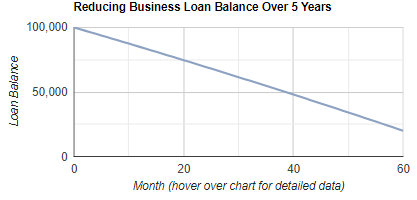
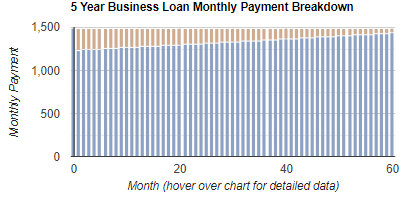
The following amortisation graphs detail month-by-month data on the progress of the proposed loan. The first chart below examines the reducing loan balance over the course of the finance contract term. The second graph illustrates the portion of each monthly repayment allocated to payment of interest vs principal reduction.
How to use our Business Loan Repayment Calculator
Our Business Loan Repayment Calculator helps you estimate business loan repayments, compare finance options and understand the true cost of borrowing before you commit. It is important because small changes to your loan amount, interest rate, term or balloon payment can materially change cash flow, total interest and end-of-term obligations. This calculator provides an indicative estimate only and is designed to support planning and budgeting for business growth.
How to complete each section for the best result:
1. Loan Amount
Enter the amount you expect to borrow as a whole number (no dots or commas). Include any costs you plan to capitalise into the loan, such as stamp duty, registration, insurance or other applicable fees, so the estimate reflects your real financed amount.
2. Balloon or Residual Payment (optional)
Select a residual as a percentage of the purchase price. A higher residual usually reduces ongoing repayments, but increases the amount due at the end and can increase total interest over the term. Choose a residual only if you have a realistic plan to refinance, pay it out, or sell an asset to meet the final amount.
3. Term of Loan
Select the number of years you want to repay the loan. A longer term generally lowers periodic repayments but increases total interest paid. A shorter term can reduce total cost but may place pressure on cash flow.
4. Interest Rate
Select an indicative annual interest rate to run a scenario. Your actual rate depends on lender assessment and your business circumstances, so consider testing multiple rates to stress-test affordability.
How to interpret the results:
1. Repayment estimate
Use the repayment figure as a budgeting guide for regular cash flow planning. If you selected a residual, remember the final payout is additional to the periodic repayments.
2. Amortisation charts
Review the reducing loan balance over time and the split between interest and principal. Early repayments typically include a higher interest component, with principal reduction accelerating later.
General information only, not personal financial advice. It does not consider your objectives, financial situation or needs. Consider the loan contract, fees, repayment frequency, and whether the repayments remain affordable under higher rates or lower revenue, and seek professional advice if required.
Recent rural coverage of the national sheep and goat electronic identification rollout is a timely reminder that compliance changes can quickly become machinery decisions. For many producers, eID is not only about tags. It can also involve scanners, panel readers, weigh systems, drafting equipment, race upgrades, software subscriptions and better connectivity around yards and loading areas. - read more
Recent rural market coverage is pointing to a more constructive winter crop outlook across several Australian growing regions, with attention now turning from seasonal potential to harvest readiness. For grain producers, the practical issue is not only whether yields improve. It is whether the farm’s machinery, labour and logistics can handle the crop efficiently if finishing conditions remain supportive. - read more
Recent rural field day coverage from AgQuip in Gunnedah has again shown how closely Australian farmers are watching machinery capability, price and timing. Major events give producers a chance to compare tractors, spray technology, handling equipment, tillage gear, harvest support machinery and digital add-ons in one place. This year, the practical takeaway is not simply that new machinery is available. It is that many farm businesses are becoming more deliberate about which upgrades are essential and which can wait. - read more
Recent rural industry coverage points to a lift in farmer confidence across parts of Australia, helped by improved seasonal conditions, firmer commodity signals and a more constructive outlook for production. For farm machinery buyers, the practical significance is not simply that optimism is returning. It is that machinery decisions which were delayed during tighter conditions may now be moving back onto the planning table. - read more
Aquaculture is a growing industry in Australia, supported by the country's extensive coastline and abundant water resources. It plays an important role in supplying seafood to both domestic and international markets and encompasses a diverse range of operations, including fish, crustaceans, molluscs and algae farming. - read more
Australia is renowned for its vast plantations and thriving forestry industry. These operations require sophisticated machinery to efficiently manage and harvest resources. From tractors to harvesters, farm machinery plays an important role in supporting modern plantation and forestry operations. - read more
Crop farming in Australia often depends on reliable machinery for planting, harvesting, irrigation and production efficiency. Machinery finance may help eligible farming businesses spread the cost of equipment over time, but the right approach depends on cash flow, seasonal income patterns, loan terms and the farm's operational needs. - read more
Livestock farming is a major part of Australian agriculture, with operations ranging across cattle, sheep, poultry and other livestock enterprises. Machinery finance can help eligible farmers consider ways to fund equipment used for feeding, handling, transport, fencing, water systems and day-to-day livestock operation management. - read more
Knowledgebase
Loan Origination Fee: A fee charged by a lender for processing a new loan application, typically expressed as a percentage of the loan amount.